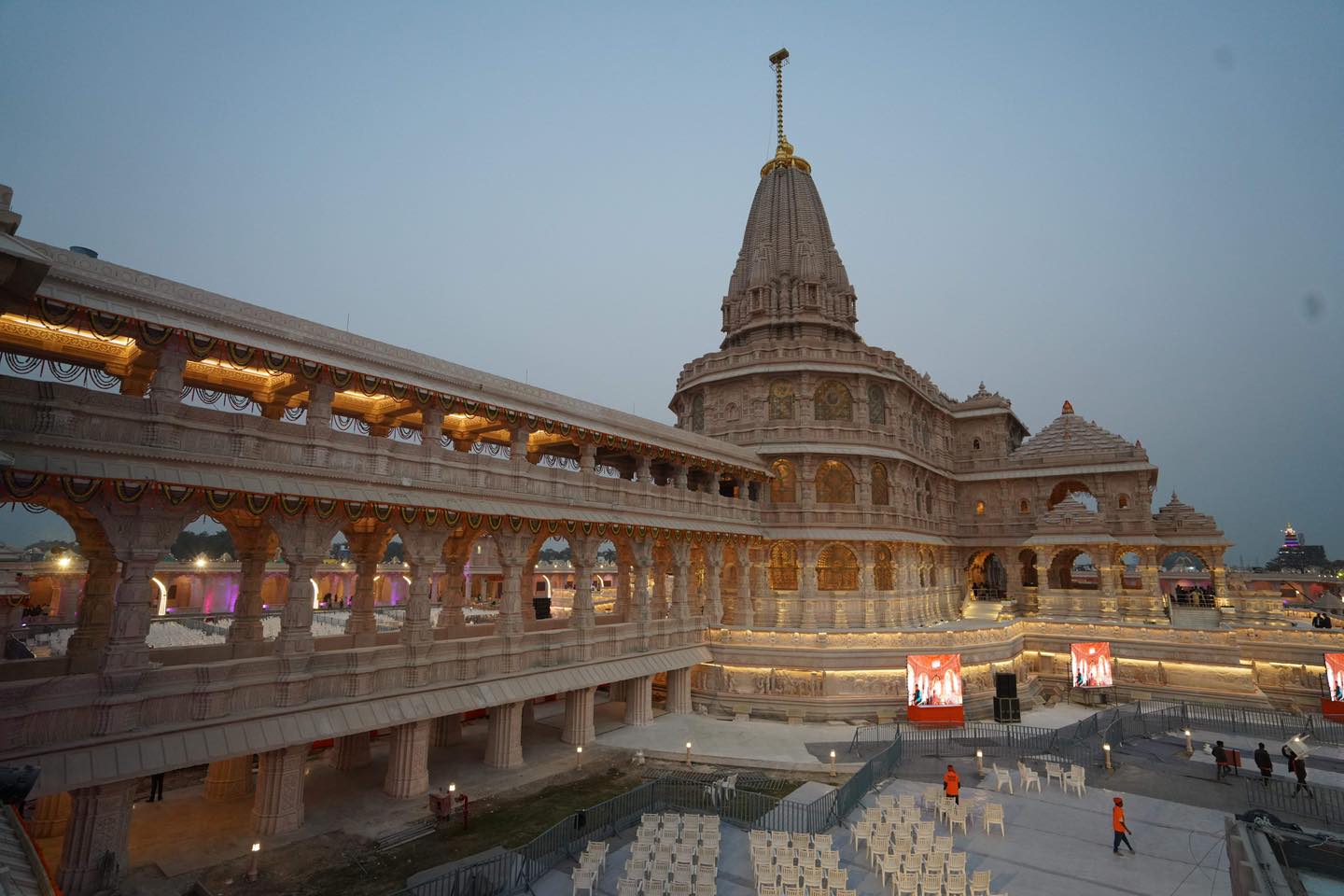

Ayodhya, the ancient and sacred city on the banks of the Sarayu River, is revered as the birthplace of Lord Shri Ram. Among its many temples and spiritual landmarks, Hanuman Garhi stands out as one of the most important and powerful shrines. Dedicated to Lord Hanuman, the temple is believed to be the divine protector of Ayodhya and a symbol of unwavering devotion, strength, and faith.
The distance between Hanuman Garhi and Ram Janmabhoomi in Ayodhya is approximately 1 to 1.2 kilometers.
Walking time: about 15–20 minutes
By auto/e-rickshaw: around 5 minutes (depending on crowd and traffic)
Most devotees prefer to walk, as the route passes through important temples and spiritual landmarks, and traditionally Hanuman Garhi is visited before Ram Janmabhoomi.
Darshan & Aarti Timing of Hanuman Garhi
The temple is open daily for devotees. The general darshan timings are:
Morning: 5:00 AM – 12:00 PM
Evening: 4:00 PM – 9:00 PM
The aarti timings at Hanuman Garhi are followed daily as per traditional rituals. The approximate schedule is:
- Morning Aarti (Mangala Aarti): 5:00 AM – 6:00 AM
- Midday / Bhog Aarti: Around 12:00 PM
- Evening Aarti (Sandhya Aarti): 7:00 PM – 8:00 PM
- Night Aarti (Shayan Aarti): Around 9:00 PM
Important Notes
- Timings may extend on Tuesdays and Saturdays, which are especially auspicious for Lord Hanuman.
- During major festivals like Hanuman Jayanti, Ram Navami, and Deepotsav, darshan hours may change due to heavy crowds and special rituals.
- Early morning and evening aarti times are considered the best for peaceful darshan.
Spiritual Significance of Hanuman Garhi
Hanuman Garhi holds a unique place in the spiritual landscape of Ayodhya. According to popular belief, devotees must first visit Hanuman Garhi before proceeding to Ram Janmabhoomi, as Lord Hanuman is considered the guardian of the city. Worshipping here is said to remove obstacles, protect devotees from negative energies, and grant courage and wisdom.
The temple strongly reflects Hanuman’s role as Ram Bhakt, emphasizing humility, service, and complete surrender to Lord Ram. Many devotees also believe that prayers offered here fulfill wishes related to health, success, and protection.
Mythological Legends Associated with Hanuman Garhi
As per Hindu mythology, after returning victorious from Lanka, Lord Ram and Goddess Sita stayed at this very place. They entrusted Hanuman with the responsibility of guarding Ayodhya. Hanuman Garhi thus became his divine abode, from where he watches over the city.
Another legend states that Mata Anjani, Hanuman’s mother, resided here, and devotees worship a small temple dedicated to her within the complex.
Architecture and Temple Structure
Hanuman Garhi is situated atop a small hill, offering a commanding view of Ayodhya. Devotees must climb approximately 76 steps to reach the main shrine, symbolizing devotion and perseverance.
The temple is built in a fort-like structure, giving it the appearance of a protective stronghold.
Inside the sanctum, the idol of Lord Hanuman is seated, facing south, with a child form of Lord Ram resting in his lap.
The temple showcases traditional North Indian architectural elements, with strong walls and a spacious courtyard.
The shrine of Mata Anjani is also an important attraction within the complex.
Historical Background
Though exact historical records are limited, it is believed that Hanuman Garhi was originally built in the 10th century. The present structure was later renovated by the Nawabs of Awadh, highlighting its importance even during medieval times. Over centuries, the temple has remained a central hub of devotion and religious activity in Ayodhya.
Rituals and Worship Practices
Daily worship at Hanuman Garhi follows traditional Vedic customs. Devotees offer sindoor (vermilion), flowers, laddoos, and oil to Lord Hanuman. Chanting of Hanuman Chalisa, Bajrang Baan, and Ram naam fills the temple with spiritual energy.
Special rituals and grand aartis are performed during:
- Tuesdays and Saturdays (considered highly auspicious)
- Hanuman Jayanti
- Ram Navami
- Deepotsav and major religious festivals
How to Reach Hanuman Garhi, Ayodhya
Hanuman Garhi is centrally located in Ayodhya, Uttar Pradesh, and is easy to reach by road, rail, and air.
1. By Air
- Maharishi Valmiki International Airport, Ayodhya – approx. 10–12 km
- Chaudhary Charan Singh International Airport, Lucknow – approx. 135 km
From the airport, you can hire a taxi or cab to reach Hanuman Garhi.
2. By Train
- Ayodhya Junction – about 2 km
- Ayodhya Cantt Railway Station – about 8 km
Autos, e-rickshaws, and taxis are easily available outside the stations.
3. By Road
Ayodhya is well connected by road with major cities of Uttar Pradesh:
- Lucknow to Ayodhya: ~135 km
- Varanasi to Ayodhya: ~200 km
- Prayagraj to Ayodhya: ~165 km
You can travel by bus, taxi, or private vehicle.
Closest / Most Convenient Parking Locations
- Hanuman Gadhi parking area – Very close to Hanuman Garhi; good for short walk access to the temple.
- Hanuman Garhi Parking – Another nearby parking spot around Sai Nagar, close to the temple area.
- Ram Janmabhoomi Parking & Sri Ram Janam Bhoomi Parking – Larger public parking areas near the Ram Janmabhoomi area (about ~1 km walk from Hanuman Garhi) — useful if closer parking is full.
- Ayodhya Parking – Another general parking option close to Ram Path road, convenient for temple visits nearby.
- Hanuman Bagh Parking Area – Smaller parking space that may be useful if the main lots are crowded.
- Ayodhya Ju Public Parking – Public parking slightly farther out but well-rated.
- Arundati Food Parking Area – Good mixed-use parking with nearby eateries.
- Ram Mandir Parking Area & Ayodhya Dhaam Parking – Useful for visiting temples in the larger Ayodhya area if central spots are full.
Parking Tips for Visiting Hanuman Garhi, Ayodhya
Parking near Hanuman Garhi can get crowded, especially during peak hours and festivals. Here are some practical tips to make your visit smooth:
1. Use Designated Parking Areas
- Prefer official parking zones near Ram Janmabhoomi or Ram Path.
- These are larger, better managed, and safer compared to roadside parking.
2. Arrive Early
- Visit early morning (before 8 AM) or late evening to easily find parking.
- Avoid peak hours like 10 AM – 2 PM and festival days.
3. Be Ready to Walk
- Most parking areas are 0.5–1.5 km away from the temple.
- Walking is often faster than driving through crowded lanes.
4. Avoid Restricted Zones
- Vehicles are often not allowed close to the temple entrance, especially during busy times.
- Follow police barricades and signage strictly
5. Consider Drop-Off Option
- If traveling with family/elderly, use cab or auto drop-off near the closest accessible point.
- Then park your vehicle farther away.
6. Use Local Transport
- After parking, take an e-rickshaw or auto to reach the temple comfortably.
7. Festival Planning
During Ram Navami, Hanuman Jayanti, Deepotsav, expect:
- Heavy traffic restrictions
- Temporary parking zones farther away
Plan extra 30–60 minutes buffer time
8. Safety Tips
- Don’t leave valuables in your car
- Park only in well-lit, authorized areas
- Keep note/photo of your parking location
Conclusion
Hanuman Garhi is not just a temple—it is a symbol of protection, devotion, and divine strength. A visit to this sacred shrine offers spiritual peace and reinforces faith in Lord Hanuman’s blessings. Whether you are a devotee of Ram bhakti or a spiritual traveler exploring Ayodhya, Hanuman Garhi remains an essential and unforgettable destination.